Good news: more and more people seem to be aware that our behavior has environmental consequences. Our waste is one of the causes of pollution, which is clearly damaging to our planet; animals and humans alike. It is time to take our responsibilities and act.
A WORLD ISSUE: EXCESSIVE PLASTIC WASTE
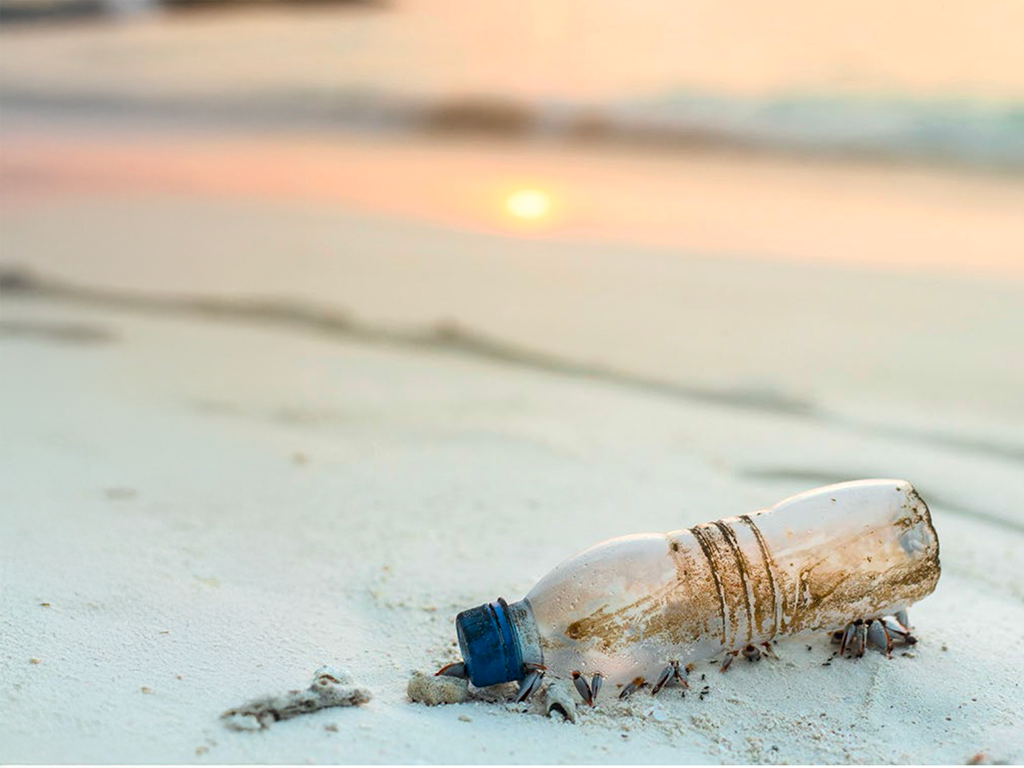
Plastic, as fast to produce as to dispose of, is nearly everywhere. Its production grows exponentially, and its intensive consumption/ use generates polluting waste. Every single second, 100 tons of waste, mostly plastic made, end up in the environment and, unfortunately a huge amount, in oceans and seas.
Some drift, mass agglutinate at the water surface, thus shaping very large Islands, and others settle on shores. “macro-plastics” are only the visible part of this pollution.
Many other objects, of any size, sink in the seabed (sometimes down to great depths), fragment more or less fast, and break up into less than 5-mm-long particles, called “secondary micro-plastics”. In addition to these, cleaning agents, additives (e.g. those used in cosmetics), fibbers and substances released from land-based pollution, are found at all sea levels, unfiltered by sewage treatment plants. These particles are called “primary micro-plastics”.
Macro-plastic pollution and the insidious one of micro-plastics have dramatic consequences for wildlife.
PLASTIC WASTE KILLS
Every year, some 450,000 land animals, among which dromedaries and camels, die from ingesting plastics left in nature. Plastics accumulate and calcify in their stomachs, filling but not feeding them.
At sea, at least 1,100,000 animals (fishes, turtles, marine mammals and birds) die, every year, from plastic ingestion (bags, polystyrene fragments…), by suffocation, or strangulation due to lost or abandoned fishing nets. Fishes, shells, and little shellfishes absorbing micro-plastics end up in our plates…
It seems certain that plastic pollution harms the ecosystem and biodiversity balance, although no numerical studies of its effects on flora have been published yet.
ENGAGEMENTS AND INITIATIVES
The United Arab Emirates and numerous countries have adopted environmental policies including waste management: home separate collection, industrial recycling, …
Over the last few years, many countries have voted for measures banning the use or distribution of some plastic products, especially disposables. A few companies already forbid a large number of these objects in their premises and commercial offers. Some of them support this change of mentality by collecting, reusing and converting. Others, forward-thinking, invest in R&D to find real alternatives to plastic.
For their part, communities, individuals and artists act, mobilize in projects and creations aiming to reduce the existing plastic waste.
That is promising, but the game is still far from being won! It is imperative that we all act upstream; no change can be made without us!
THE RIGHT STEPS TO REDUCE WASTE
Today, if we still find it difficult to avoid using plastic in our daily life, we can choose to do our shopping with a reusable bag, ban the purchase of disposables, choose bulk products rather than packaged or wrapped ones and opt for non-plastic materials, especially cardboard, wood games and toys.
It is also easy to select beauty and hygienic products with no “polyethylene”, “carbomer”, “co-polymer”, “acrylate”, and “polyquat”, or “-one”, “-oxane”, “-siloxane”, “-polymer”, and “-vinyl” endings. Fortunately, many mobile applications are helpful in this regard.
We can limit the purchase of synthetic clothes, as they lose their fibbers during washing. Upon placing our home meal orders, specify we wish useless plastic cutlery and straws were not delivered. Do not throw any waste or cigarette buds out of trashcans. After a family picnic, collect and bring back home all the waste to be sorted. And last, politely tell the people proving to be irresponsible and uncivilized, to pick up their waste.
These simple gestures have several and positive impacts. For instance, they encourage Industrials to modify the composition and packaging of their products. Each action contributes to safeguard our planet, its inhabitants, plants and animals; the ecosystem on which all living beings depend.
THE ESTIMATED TIME OF WASTE DECOMPOSITION IN THE NATURAL ENVIRONMENT
Biodegradable Plastic: Not all plastic is 100% biodegradable. The only one is exclusively made of vegetable materials and decomposes thanks to the action of micro-organisms slowly feeding on it. However, depending on the location, its biodegradation is more or less difficult, especially in the marine environment.
Polystyrene: There are different kinds of polystyrene. Its decomposition can take from a few years to one million, depending on its location (buried, on the ground benefiting from phytodegradation, at sea…)
Glass: No less than 5,000 years or never. However, a high percentage is recyclable and, above all, reusable.